Sign In / Create Account
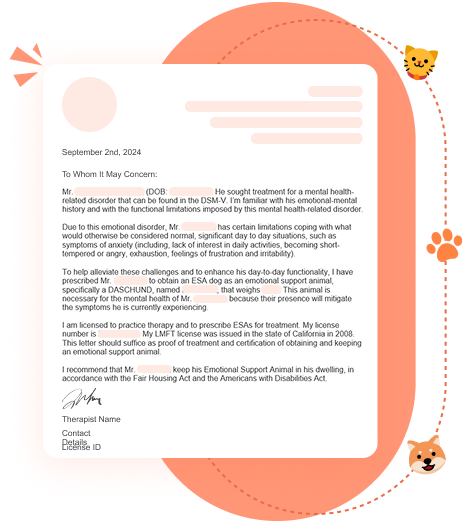











What You Need to Know About ESA Letters in Vermont
In Vermont, Emotional Support Animals (ESAs) are recognized as essential therapeutic companions for individuals managing mental or emotional health conditions. Evaluated by a state-licensed healthcare provider, your official ESA letter guarantees housing rights under the federal Fair Housing Act (FHA) and Vermont state laws.
With valid ESA documentation, Vermont landlords must grant reasonable housing accommodations, overriding no-pet rules and waiving pet deposits, monthly pet fees, and breed/size restrictions across Burlington, South Burlington, Rutland, Barre, Montpelier, and Winooski.

Get Your ESA Letter in Vermont in 4 Easy Steps
Follow our streamlined process to obtain your official ESA letter from a licensed Vermont clinician:
- Complete a brief online assessment outlining your mental health symptoms.
- Connect with a licensed Vermont healthcare professional for evaluation.
- Finalize your request and secure payment.
- Receive your approved digital ESA letter within 24 hours, with optional physical delivery.
100% money-back refund guarantee if your housing request is legally rejected under valid rules.
Are You Eligible for an ESA Letter in Vermont? Let's Find Out
If you're managing a recognized mental health condition under DSM-5 guidelines, you may qualify for an ESA letter in Vermont. Our licensed clinicians conduct thorough evaluations to determine whether an assistance animal will support your psychological health.
Common qualifying conditions include:
- Generalized Anxiety Disorder
- Major Depressive Disorder
- Post-Traumatic Stress Disorder (PTSD)
- Social Anxiety Disorder
- Bipolar Disorder
- Obsessive-Compulsive Disorder (OCD)
- Panic Disorder & Panic Attacks
- Attention Deficit Disorder (ADD/ADHD)
- Autism Spectrum Disorder
If you experience any of these conditions, our evaluations are recognized in all states. Begin your assessment to secure your housing rights.
Start My AssessmentUnderstand the ESA Laws in Vermont
Emotional support animals in Vermont are protected under the Vermont ESA laws. Individuals with valid letters are protected by specific ESA laws that ensure their rights in housing and travel situations.
Under both federal and state laws, individuals with ESA letters in Vermont are granted important protections. The FHA housing laws allow tenants to live with their emotional support animals, even in properties that usually prohibit pets.
Similarly, the Air Carrier Access Act (ACAA) provides rights for traveling with an ESA on airplanes, although airline regulations have become stricter recently.
Fair Housing Act (FHA) and ESA Rights in Vermont
The FHA ensures that individuals with ESA letters cannot be discriminated against in housing situations. Landlords must allow ESAs as a reasonable accommodation, even if their property has a no-pet policy, as long as the tenant provides proper documentation. They are also not allowed to charge an additional pet fee for the ESA.
- ESAs in the Workplace
Most workplaces in Vermont don't have to allow ESAs. Only service animals, which are trained to do specific jobs, are protected by law at work. Your boss might let you bring an ESA, but they don't have to.
- Misrepresenting an ESA as a Service Animal
It's against the law to say your ESA is a service animal if it's not. If you do this, you could get in trouble. To have an ESA protected in housing, you must have a letter from a licensed mental health professional.

Traveling with an ESA in Vermont
The Air Carrier Access Act (ACAA) does not require airlines to accept emotional support animals. Most airlines now treat ESAs like regular pets. This means owners may have to pay pet fees and follow pet travel rules. It is important to check airline policies before flying.
- Airlines may require advanced notice (48 hours or more) for ESA travel.
- ESAs must be well-behaved and remain under control during the flight.
- Certain airlines may ask for additional documentation or forms for your ESA.
- Some airlines have specific guidelines on the size and breed of ESAs allowed.
It’s essential to check the specific airline’s policies before booking to ensure smooth travel with your ESA.
What Our Clients Are Saying
Discover real feedback from clients who secured valid Vermont ESA documentation through our network:



















Why Choose Real ESA Letter?
- Expert licensed professionals dedicated to your well-being
- Quick, easy, and secure online process
- Fast approval and digital delivery of your ESA letter
- Fully compliant with Vermont and federal regulations
- Transparent, affordable pricing with no hidden fees
- 24/7 support to assist you every step of the way
- Guaranteed satisfaction or your money back
Frequently Asked Questions
How long is an ESA letter valid?
An ESA letter is usually valid for one year. After that, ESA letter is renewed by a licensed mental health professional if the person still needs an emotional support animal. There is no need to get a completely new letter—just an updated version confirming the ongoing need for the ESA.
Can an ESA letter be used for both housing and travel?
An ESA letter can be used for housing but not for travel. The Fair Housing Act (FHA) allows people to live with emotional support animals, even in housing that does not allow pets.
However, airlines do not have to accept emotional support animals anymore. Most treat them as regular pets. This means owners must follow pet travel rules, including fees and carrier requirements.
What if my landlord refuses to accept my ESA letter?
If your landlord refuses to accept your ESA letter, they are violating the Fair Housing Act. You have the right to challenge the denial by providing proper documentation. Vermont follows federal housing protections, which ensure that you can live with your ESA in housing that otherwise prohibits pets.
What documentation do I need to provide for my ESA letter?
To get an ESA letter in Vermont, you need to provide basic information about your mental health condition, which will be assessed by a licensed therapist. You may also be asked for past medical records if relevant to your condition.
Can I get an ESA letter if I have a pet that isn’t a dog or cat?
Yes, dogs and cats are the most common ESAs, but other animals can qualify, too. A licensed mental health professional must confirm that the animal helps with emotional or mental well-being.
Is an ESA letter different from a service animal certification?
Yes, an ESA letter is different from a service animal certification. An ESA provides emotional support, while service animals are trained to perform specific tasks for individuals with disabilities. ESAs do not require specific training like service animals do.
Can I bring my ESA to work?
Federal laws do not require employers to allow emotional support animals at work. The Americans with Disabilities Act (ADA) only protects service animals, not ESAs. However, some employers may allow ESAs as a workplace accommodation. It’s best to check company policies or discuss options with your employer.
Do I need to disclose my ESA letter to my landlord or airline in advance?
Yes, you need to provide your ESA letter in advance if you're seeking to have your ESA in a no-pet housing situation or to travel with your ESA. For housing, your landlord should receive the letter before moving in. For airlines, you typically need to submit the letter at least 48 hours before your flight.
Get an ESA Letter in Your State
Northeast
Southeast
- Florida ESA Letter
- Georgia ESA Letter
- North Carolina ESA Letter
- Virginia ESA Letter
- Tennessee ESA Letter
- Maryland ESA Letter
- South Carolina ESA Letter
- Alabama ESA Letter
- Kentucky ESA Letter
- Louisiana ESA Letter
- Arkansas ESA Letter
- Mississippi ESA Letter
- West Virginia ESA Letter
- Delaware ESA Letter
- Washington DC ESA Letter
Midwest
Get Your ESA Letter Today and Experience the Benefits!
Take control of your well-being! Secure your ESA letter today and access the support and protection you deserve!
Start Now
WRITTEN BY REAL ESA LETTER EDITORIAL TEAM
Medically reviewed by Tina Logan, LMFT
Licensed Marriage & Family Therapist · License #46136 · Reviewed on June 5, 2026
Last updated: June 2026
Medical Disclaimer: The information on this page is for general guidance only and is not legal or medical advice. Eligibility for an emotional support animal letter is determined by a licensed mental health professional during your evaluation. Letters are issued only when clinically appropriate.