Sign In / Create Account
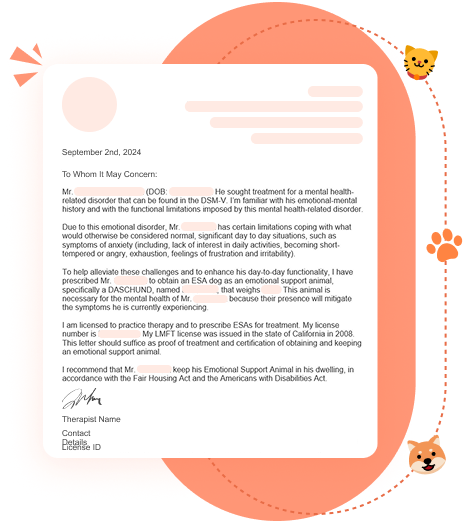











Why You Need an ESA Letter in Utah
If you live in Utah and manage anxiety, depression, PTSD, or another qualifying emotional condition, an Emotional Support Animal (ESA) provides essential daily therapeutic comfort. To legally protect your pet in rental housing, you need an official ESA letter evaluated by a state-licensed healthcare provider.
Issued under federal Fair Housing Act (FHA) rules and Utah ESA laws, your documentation legally guarantees housing rights, waiving pet deposits, monthly pet fees, and breed restrictions across Utah properties—including Salt Lake City, Provo, Ogden, St. George, and Logan.

How to Order Your ESA Letter in Utah
- Complete a short online questionnaire to outline your mental health history.
- Connect with a licensed Utah mental health professional for a clinical review.
- Finalize your order securely while your provider completes your evaluation.
- Receive your approved digital ESA letter within 24 hours, with optional physical delivery.
100% money-back refund guarantee if your housing request is legally rejected under valid rules.
How to Qualify for an ESA Letter in Utah
To qualify for an ESA letter in Utah, you must be diagnosed with a recognized mental health condition under DSM-5 standards. A state-licensed healthcare provider will assess whether an emotional support animal provides essential therapeutic assistance to alleviate your symptoms.
Common qualifying conditions include:
- Major Depressive Disorder
- Generalized Anxiety Disorder
- Post-Traumatic Stress Disorder (PTSD)
- Panic Disorder & Panic Attacks
- Obsessive-Compulsive Disorder (OCD)
- Bipolar Disorder
- Attention Deficit Hyperactivity Disorder (ADHD)
- Social Anxiety Disorder
- Specific Phobias
- Schizophrenia & Mood Disorders
If you're unsure whether you qualify, you can learn how to ask a doctor for an ESA and connect with our licensed Utah clinicians for a confidential online evaluation.
Get StartedHow ESA Laws in Utah Protect You and Your Animal
ESAs are protected under emotional support animal laws that make sure you and your ESA can live together with ease. Here’s what you need to know about ESA laws in Utah:
Housing Protections (Fair Housing Act)
Under the Fair Housing Act, landlords or property managers in Utah are required to provide reasonable accommodations for tenants with ESAs. This means they can’t refuse to rent to you just because you have an ESA, even if their building has a no-pets policy. They also can’t charge you additional pet fees or deposits for your ESA. All you need is a valid ESA letter from a licensed professional to ensure your rights are protected, as outlined by the Department of Housing and Urban Development.
- No Public Access Rights
It’s important to know that ESAs don’t have the same public access rights as assistance animals. This means that your ESA is not allowed in public places like restaurants, stores, or public transportation, where pets are typically not allowed. ESAs are meant to provide support in your living space and emotional comfort, but they don’t have access to all public areas.
- No Airline Protections
Recent changes to the Air Carrier Access Act now mean that ESAs are no longer recognized as service animals by airlines. This change has removed the right for ESAs to fly for free as service animals. Now, they may be treated as regular pets, which means you’ll need to check with your airline about their pet policy and any additional fees for bringing your ESA on board.
What Our Customers Are Saying
Thousands of people trust Real ESA Letter to provide reliable ESA letters that guarantee housing rights.








Top Reasons to Choose Real ESA Letter for Your ESA Letter
- Real ESA Letter makes getting your ESA letter fast and hassle-free.
- Licensed mental health professionals guide you through the entire process.
- Our ESA letters are fully compliant with all legal requirements.
- Receive your ESA letter quickly, so you can enjoy the benefits without delay.
- Your personal information is always kept secure and confidential.
- Enjoy a seamless and easy-to-use website experience from start to finish.
- Our dedicated customer support team is ready to assist you 24/7.
- Transparent pricing with no hidden charges
Frequently Asked Questions
Can I write my own ESA letter?
No, you cannot write your own ESA letter. It must be issued by a licensed mental health professional who evaluates your need for an Emotional Support Animal.
Do you have to pay a pet deposit for an emotional support animal in Utah?
No, you do not have to pay a pet deposit for your ESA in Utah. Landlords cannot charge additional fees or deposits for your ESA under the Fair Housing Act.
How can I get my ESA letter fast?
To get your ESA letter quickly, complete a brief online assessment on Real ESA Letter. Once approved by a licensed therapist, your digital letter is issued within 24 hours.
Can hotels charge for emotional support animals in Utah?
No, hotels in Utah cannot charge extra fees for emotional support animals (ESAs) under the housing law. However, some hotels may have their own policies for pets, so it's always a good idea to check with the hotel before booking..
When can a landlord legally reject an ESA in Utah?
A landlord in Utah can legally reject an Emotional Support Animal (ESA) if the animal poses a direct threat to the health or safety of others, causes significant property damage, or if the tenant fails to provide a valid ESA letter from a licensed professional. However, they cannot reject an ESA simply because they have a no-pets policy or charge additional fees or deposits for the animal.
How do ESA Letters in Utah differ from those in other States?
ESA letters in Utah follow the same federal guidelines as other states, but it is important to note that Utah landlords or property managers may have specific local requirements for documentation. ESA letters must be issued by a licensed mental health professional who evaluates the tenant's need for an emotional support animal under the Fair Housing Act.
Is there an Official Registration for ESAs in Utah?
No, there is no official registration for Emotional Support Animals in Utah. ESAs are not required to be registered or carry specific identification. What matters is that you have a valid ESA letter from a licensed mental health professional that outlines your need for an emotional support animal.
Do ESA Letters in Utah need to be Renewed Annually?
Yes, ESA letters must be renewed annually in Utah. To maintain the legal protections and benefits that come with having an ESA, you need to get a new letter from a licensed mental health professional each year.
Can I get a free ESA letter in Utah?
While there are some services that claim to offer a free ESA letter in Utah, it's important to be cautious. Legitimate ESA letters require a licensed mental health professional to evaluate your condition, which comes with a cost. Always ensure you’re working with a reputable service to avoid scams.
What is the ESA letter Utah cost?
At Real ESA Letter, the cost of an ESA letter in Utah ranges from $149 for Housing or PSD Travel Letters to $199 for the combined package. Same-day delivery and annual renewal discounts are available.
Get an ESA Letter in Your State
Northeast
Southeast
- Florida ESA Letter
- Georgia ESA Letter
- North Carolina ESA Letter
- Virginia ESA Letter
- Tennessee ESA Letter
- Maryland ESA Letter
- South Carolina ESA Letter
- Alabama ESA Letter
- Kentucky ESA Letter
- Louisiana ESA Letter
- Arkansas ESA Letter
- Mississippi ESA Letter
- West Virginia ESA Letter
- Delaware ESA Letter
- Washington DC ESA Letter
Midwest
Get Your ESA Letter in Utah in Just a Few Simple Steps
Start the process of getting your emotional support animal letter today. It's quick, easy, and all online.
Start Assessment
WRITTEN BY REAL ESA LETTER EDITORIAL TEAM
Medically reviewed by Tina Logan, LMFT
Licensed Marriage & Family Therapist · License #46136 · Reviewed on June 5, 2026
Last updated: June 2026
Medical Disclaimer: The information on this page is for general guidance only and is not legal or medical advice. Eligibility for an emotional support animal letter is determined by a licensed mental health professional during your evaluation. Letters are issued only when clinically appropriate.